Workforce Development and Education: Integrating Extended Reality to Enhance Learning Experiences
Workforce Development and Education: Integrating Extended Reality to Enhance Learning Experiences
Research Team: Alejandro Martin Gomez, Ph.D.
Some subjects and professional skills are difficult to teach through lectures, textbooks, or two-dimensional images alone. Learners may benefit from opportunities to explore complex information spatially, practice tasks, and collaborate in interactive environments.
This research examines how extended reality, or XR, can support education and workforce development. XR combines computer-generated content with a user’s physical surroundings or places the user within a simulated environment. These technologies can allow learners to interact with three-dimensional information and participate in experiences that would be difficult to reproduce in a conventional classroom.
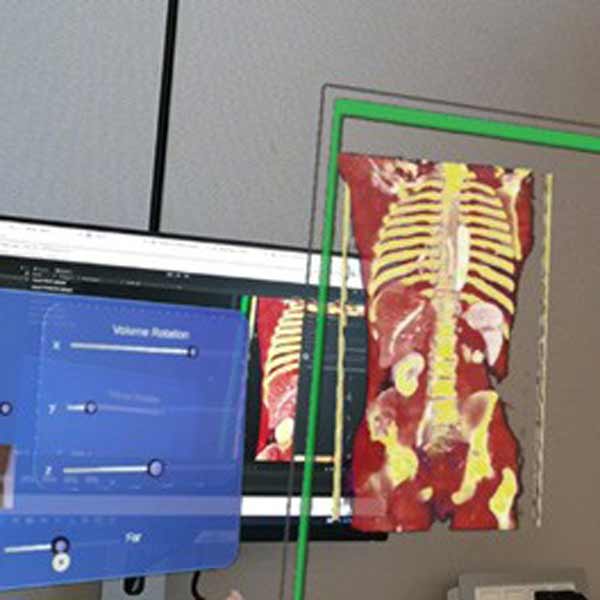
One area of focus is anatomy education, where XR may help learners explore the spatial relationships among anatomical structures from multiple perspectives. The research also investigates how XR can support collaboration and create experiences adapted to individual learners.
Our goal is to determine where XR provides meaningful educational value and how these experiences should be designed for effective, accessible, and practical use. By evaluating how learners engage with and learn from XR, this work could inform new approaches to education, professional training, and workforce preparation.