Restored Touch
Restored Touch
Research Team: Andres Pena, Ph.D.; Tommaso Benigni, Ph.D.; Sathyakumar Kuntaegowdanahalli, Ph.D.; Justin Asbee, Ph.D.; James Abbas, Ph.D.; Ranu Jung, Ph.D.
Industry Partners: Medipace, Regulife Medical, Biocircuit, Terran Gates / Gates Prosthetics + Mobility Clinic, TASKA Prosthetics, PSYONIC.
Clinical Trial Currently Open Visit ans.uark.edu to learn more
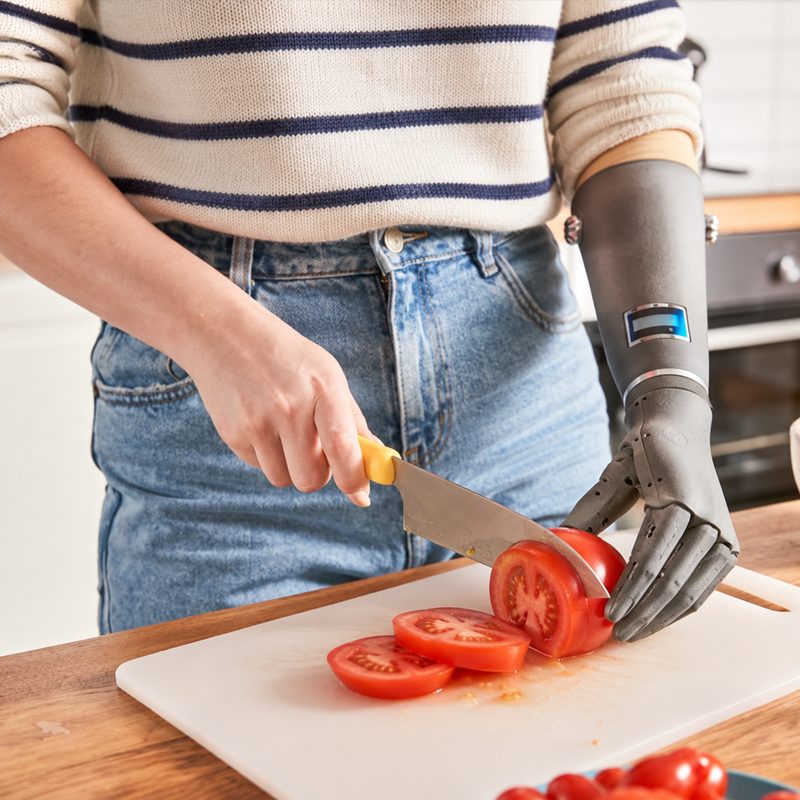
Modern prosthetic hands can help people grasp and manipulate objects, but most do not restore the sense of touch. As a result, users often must rely on vision to determine whether an object has been contacted or how firmly it is being held, making everyday tasks more difficult and less intuitive.
Restored Touch (rTouch) is a non-invasive, wearable neuro-haptic system designed to provide meaningful sensory feedback for people with below-elbow amputations. Sensors embedded in a prosthetic hand detect interactions with objects and translate that information into carefully controlled electrical stimulation delivered through electrodes placed on the residual limb. This stimulation can evoke intuitive sensations that users perceive as originating from their missing hand.
When a prosthetic hand grasps an object, rTouch can provide immediate sensory information associated with that interaction. The project evaluates how this feedback influences prosthesis control, task performance, user confidence, and embodiment, the feeling that the prosthesis is part of the body.
The system uses advanced neurostimulation strategies and multi-channel surface electrode arrays to create localized, task-relevant sensations while minimizing unintended or confusing percepts. Researchers are also developing adaptive stimulation controls, portable clinical-grade hardware, and embedded electrode technologies that support comfortable, practical daily use.
Designed for clinical adoption and real-world use, rTouch is being developed to integrate with commercially available prosthetic systems. The research examines not only how effectively sensory information can be restored, but also how reliably, comfortably, and easily the technology can be used in clinical and everyday settings.
By helping bridge the sensory gap between a person and their prosthetic hand, rTouch aims to make prostheses more intuitive, functional, and effective. Ultimately, this work seeks to reduce the functional impact of upper-limb loss and improve independence and quality of life for people living with amputation.