Neural-Enabled Prosthetic Hand
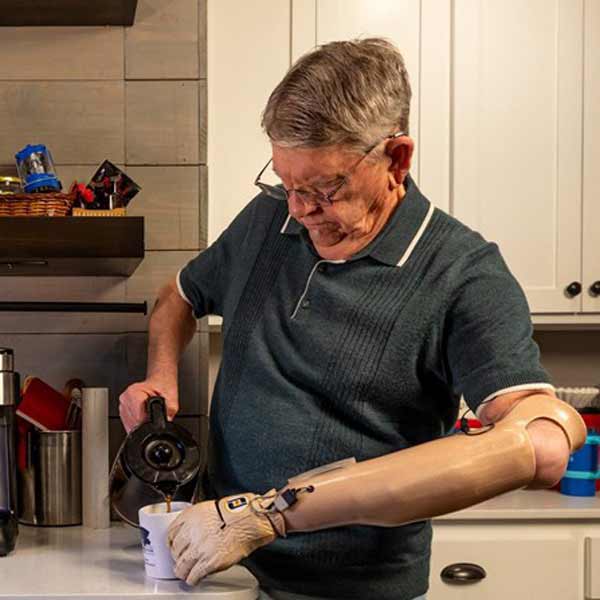
Neural-Enabled Prosthetic Hand
Research Team: Ranu Jung, Ph.D., James Abbas, Ph.D., Sathyakumar Kuntaegowdanahalli, Ph.D., Andres Pena, Ph.D., Justin Asbee, Ph.D., Hailey Dirrigl, Diego Aguilar, Tommaso Benigni, Ph.D., Aliyah Shell, Ph.D., Avery Holmes.
Industry/Academic/Community Partners: University of Arkansas for Medical Sciences, Walter Reed National Military Medical Center, Gates Prosthetics Mobility Clinic, Snell Prosthetics & Orthotics, Cochlear Ltd, TASKA, Fillauer, NAMSA.
Visit ans.uark.edu to learn more.
Providing the sensation of touch to people who use a prosthetic hand
The neural-enabled prosthetic hand system is designed to provide the sense of touch, grasp force, and prosthetic hand opening to individuals with upper limb amputation who use a prosthesis. By restoring sensory feedback, the system aims to improve users' ability to interact with everyday objects and increase independence in daily activities. It wirelessly communicates information from prosthesis-mounted sensors and electronics to an implanted neurostimulator connected to fine-wire electrodes implanted in peripheral nerves.
Under the leadership of Drs. Ranu Jung and James Abbas, a first-in-human clinical trial has been approved by the FDA, with study sites at the University of Arkansas and the Walter Reed National Military Medical Center. Eight people in the world (five from Arkansas) have received the novel investigational device with surgical implants conducted at University of Arkansas Medical Sciences, Walter Reed National Military Medical Center and the Nicklaus Children’s Hospital.
This highly translational research program is focused on delivering solutions that individuals with amputation can utilize in real-world environments on a daily basis. As such, the clinical trial includes an extended period in which participants use the prosthetic system that provides sensation in their everyday activities to address such questions as: Is it easy to use? Are the sensations comfortable and useful? Does it improve their ability to perform everyday activities? Does it provide sustained value to the user?