MOBILS: Modular Bionic Limb Sensory System for Stability and Mobility
MOBILS: Modular Bionic Limb Sensory System for Stability and Mobility
Research Team: Andres Pena, Ph.D.; James Abbas, Ph.D.; Sathyakumar Kuntaegowdanahalli, Ph.D.; Tommaso Benigni, Ph.D.; Arianna Ortega Sanabria, Ph.D.
Industry, Academic, and Community Partners: USC Center for Autonomic Nerve Recording and Stimulation Systems (CARSS), Medipace Inc., Med-Ally LLC.
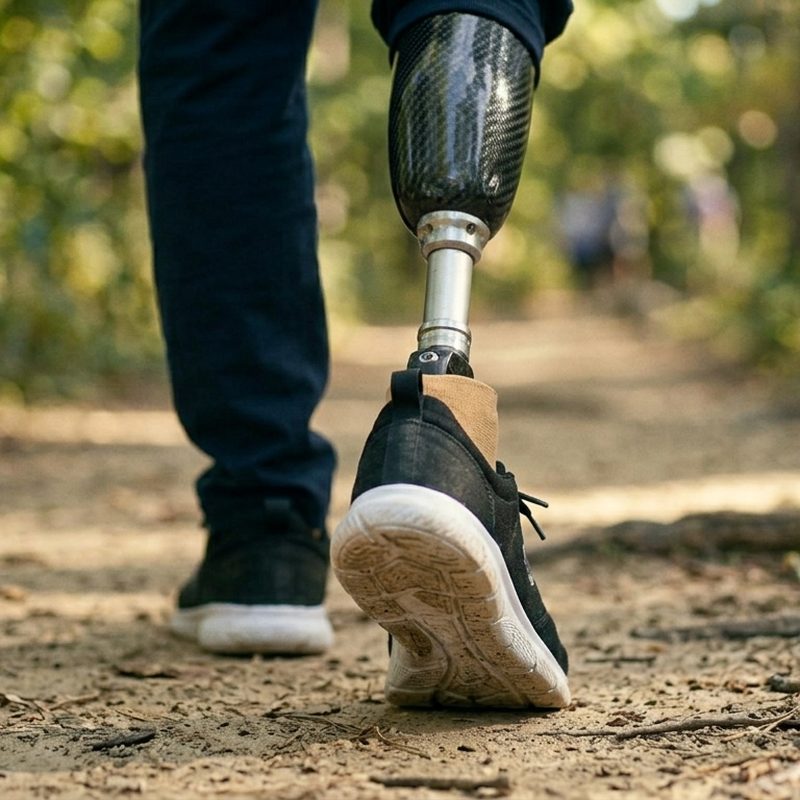
Modern lower-limb prostheses can help restore movement, but they do not restore the natural sense of touch from the missing foot. As a result, many people with below-knee amputations must watch where they place the prosthesis and consciously monitor each step. This can make it more difficult to maintain balance, walk on uneven ground, and move confidently through everyday environments. The loss of sensory feedback contributes to instability, increased fall risk, and greater mental effort during walking.
MOBILS, the Modular Bionic Limb Sensory System for Stability and Mobility, is an implantable sensory neuroprosthetic system designed to address this gap. The system uses sensors attached to a conventional prosthesis to measure interactions between the prosthetic foot and the ground and converts that information into targeted stimulation of sensory nerves in the residual limb.
The goal is to create localized, foot-like sensations that provide useful information about contact, pressure, and movement. For example, when the prosthetic foot contacts the ground or a user shifts weight while standing, MOBILS is designed to provide corresponding sensory feedback. This is intended to help users perceive and respond to their environment without depending as heavily on vision and conscious attention.
MOBILS creates a closed-loop connection between the prosthesis and the nervous system. Sensors continuously detect what is happening at the prosthetic foot, and an implanted neural interface stimulates selected sensory nerve fibers to return that information to the user in real time. This project will investigate whether this feedback can improve stability, mobility, confidence, and the mental effort required during standing and walking.
The platform builds on previous clinical experience with implantable sensory neuroprosthetic systems and uses a modular design that allows sensing, stimulation, and prosthetic components to evolve as the technology advances. The project extends this work to address the specific challenges faced by people who use lower-limb prostheses.
Moving an implantable technology from the laboratory into clinical care requires more than engineering innovation. The MOBILS team is addressing rehabilitation, surgical use, safety, regulatory review, and long-term accessibility alongside the technical research. People with limb loss, clinicians, prosthetists, therapists, surgeons, researchers, and industry partners contribute perspectives intended to ensure that the system addresses meaningful real-world needs.
By restoring information that is normally lost after amputation, MOBILS seeks to make walking with a prosthesis safer, more natural, and less mentally demanding. The long-term goal is to reduce fall risk, support greater independence, and improve mobility and quality of life for people with lower-limb amputation.