Extended Touch
Extended Touch
Research Team: Andres Pena, Ph.D.; Tommaso Benigni, Ph.D.; Sathyakumar Kuntaegowdanahalli, Ph.D.; Justin Asbee, Ph.D.; James Abbas, Ph.D.; Ranu Jung, Ph.D.
Industry/Academic/Community Partners: Medipace, Regulife Medical, Biocircuit
Clinical Trial Currently Open Visit ans.uark.edu to learn more
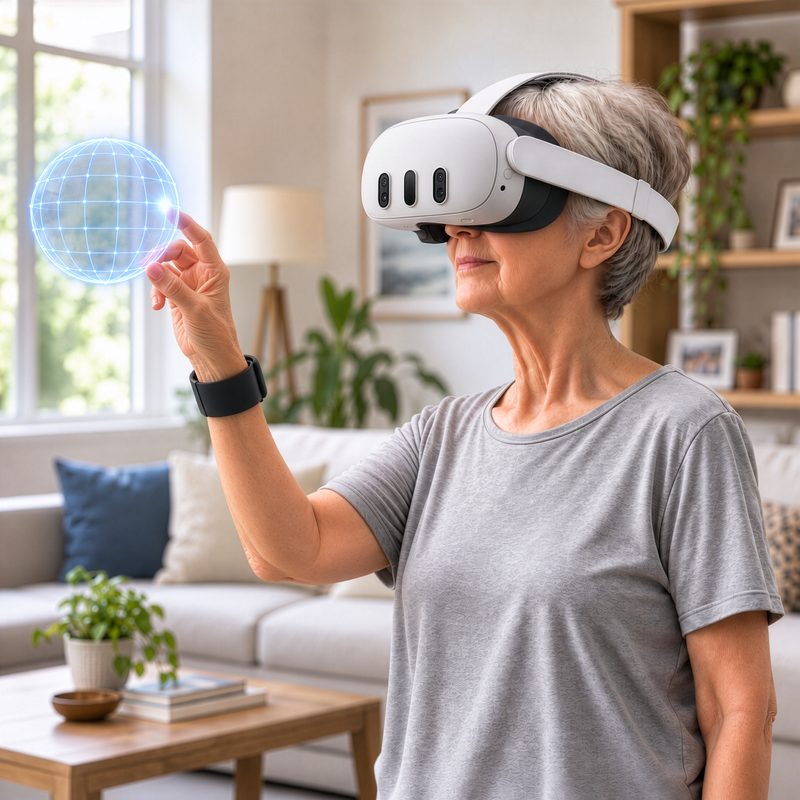
Extended Touch (xTouch) is a non-invasive wearable neuro-haptic platform that recreates the sense of touch in virtual environments through peripheral nerve stimulation. By delivering task-relevant sensory information directly through the nervous system, xTouch allows users to feel virtual interactions without relying on bulky mechanical actuators, opening new possibilities for rehabilitation, training, and human-computer interaction.
Touch plays a fundamental role in how we control movement and interact with the world. Following a stroke or other neurological injury, disrupted sensory feedback can make everyday tasks more difficult and hinder recovery. While virtual rehabilitation technologies can create engaging visual experiences, they often cannot reproduce the sensation of physically interacting with objects. xTouch addresses this gap by restoring meaningful touch sensations during virtual activities.
Using carefully controlled electrical stimulation of peripheral nerves, xTouch evokes localized sensations that can be perceived at functionally relevant locations, such as the hand or fingers during a virtual object-manipulation task. The platform integrates wearable neurostimulation technology with extended-reality systems to synchronize touch sensations with events occurring in a virtual environment. For example, a user can feel when a virtual hand contacts, grasps, or moves an object.
Our research initially focuses on sensorimotor rehabilitation for individuals recovering from stroke and other neurological or physical impairments. By reintroducing meaningful sensory information during therapeutic activities, xTouch aims to improve engagement, strengthen motor learning, and support more effective rehabilitation in both clinical and home settings. The platform also serves as a powerful research tool for studying how people perceive artificial touch, how sensory feedback shapes movement, and how neurotechnology can enhance interactions between humans and machines.
Beyond rehabilitation, xTouch has broad applications in surgical robotics, teleoperation, immersive training, defense systems, and next-generation digital interfaces. By restoring and extending the sense of touch in digital and remote environments, xTouch seeks to make remote interaction more natural, improve training realism, enhance operator awareness, and expand the ways people interact with technology.